Republished from author-approved historical weekly content; the batch date does not represent the actual social-platform publication date.
Author
Steve
Issue date
Facebook visible date
8月7日
Website publication
Original social publication date
Not confirmed
One decision I made this week may sound conservative, but I believe it will help the project move faster:
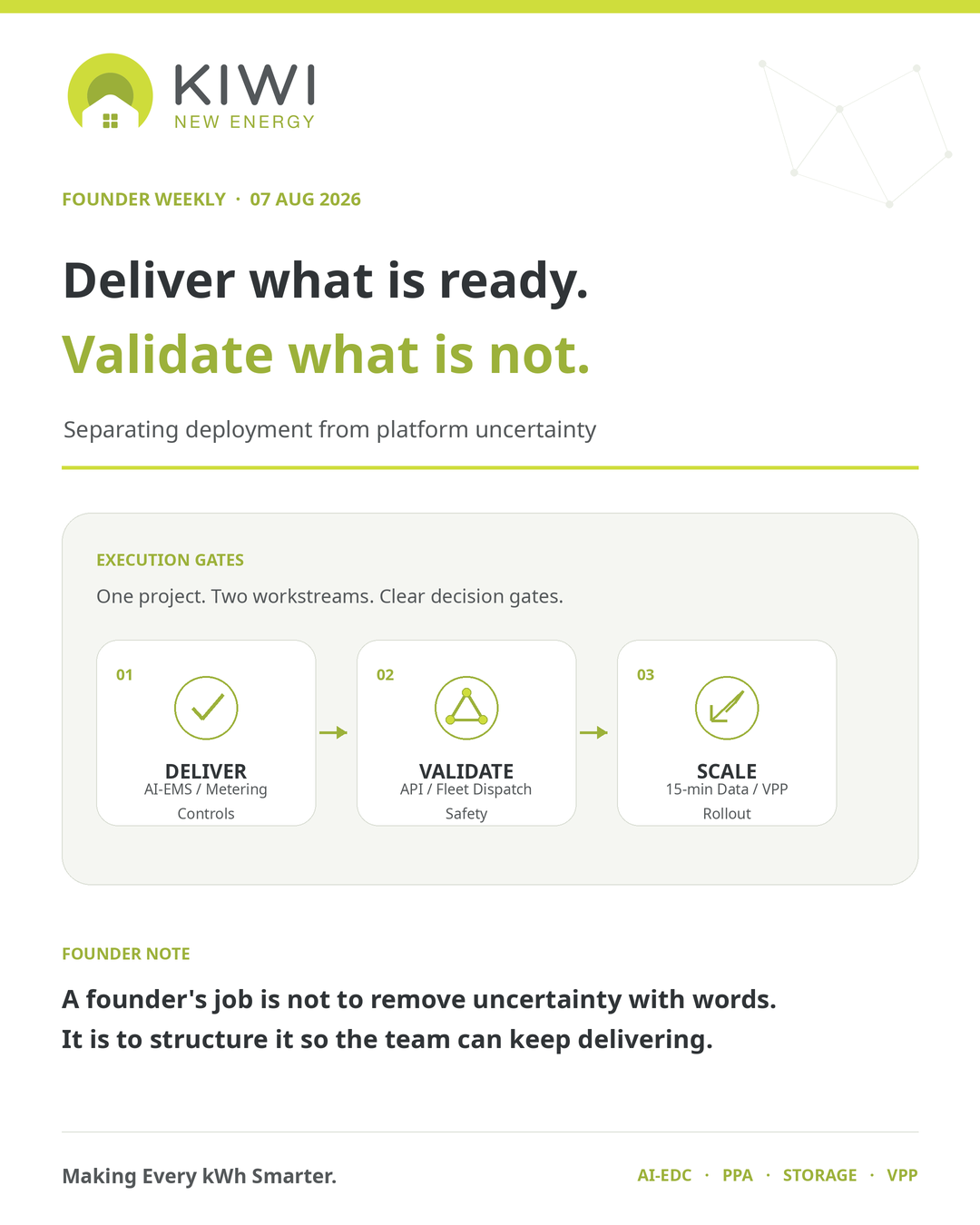
Deliver what is ready, and separate what still needs to be proven.
In one multi-site retail energy project, the scope for AI-EMS, metering, site controls and the first storage installation is clear enough to execute.
The commercial API, fleet-level dispatch, VPP participation and grid-service functions are not yet at the same stage.
They still depend on access rights, command behavior, connectivity recovery, fail-safe logic, product availability, service commitments and market qualification.
These are not details we can resolve with one sentence in a proposal.
If we tie everything together, the work that is ready gets stuck behind the work that is uncertain.
But if we sell an untested capability as a commitment, the project may move faster for a few weeks and then fail much more expensively.
So we split the project into two tracks.
The first track continues with delivery: site installation, metering, equipment control and AI-EMS.
The second becomes a formal validation program covering API authorization, telemetry, command confirmation, rollback, connectivity loss, safe-state behavior and 15-minute performance data.
Every item needs an owner, a test method and a clear acceptance gate.
When the evidence is there, we move forward.
When it is not, we do not turn an assumption into a customer commitment.
That is also the main execution lesson I am taking from this week.
In a complex energy project, the bottleneck is often not one missing device. It is an unclear interface, an undefined responsibility or an acceptance standard that was never agreed.
AI loads, battery storage, distributed sites and electricity markets are becoming increasingly connected.
The winning architecture will not be one device or one application.
It will be a system that knows which resources are available, what they are allowed to do, when they should respond and how their performance can be verified.
This is where I see KiWi’s role.
We are not trying to place more features on a slide.
We are working to connect renewable power, PPAs, storage, VPP, enterprise loads and 15-minute energy data into a system that can be operated, tested and improved in the real world.
A founder’s job is not to remove uncertainty with words.
It is to structure uncertainty so the team can keep delivering.
Deliver what is ready.
Validate what is not.
Scale when the evidence is there.
Making Every kWh Smarter.
Steve Huang
Founder & CEO, KiWi New Energy
#KiWiNewEnergy #AIInfrastructure #AIDataCenters #EnergyStorage #PPA #VPP #EnergyTech #EnergyTransition