Solar power "directly delivered by Taipower" to your home — startup KiWi launches home green energy platform
KiWi unveils Taiwan's first home green energy subscription platform — direct Taipower delivery, AI-matched 15-minute dispatch, and plans starting at NT$499/month.
The United Nations Climate Change Conference (COP26) was just held last month, and the common global goal is to achieve "net-zero carbon emissions" by 2050, a commitment the Taiwan government has also made. But ordinary citizens are puzzled: 100% of the electricity used every day is highly polluting "grey electricity," and green electricity is almost something you only hear about but cannot use. How should we transition?
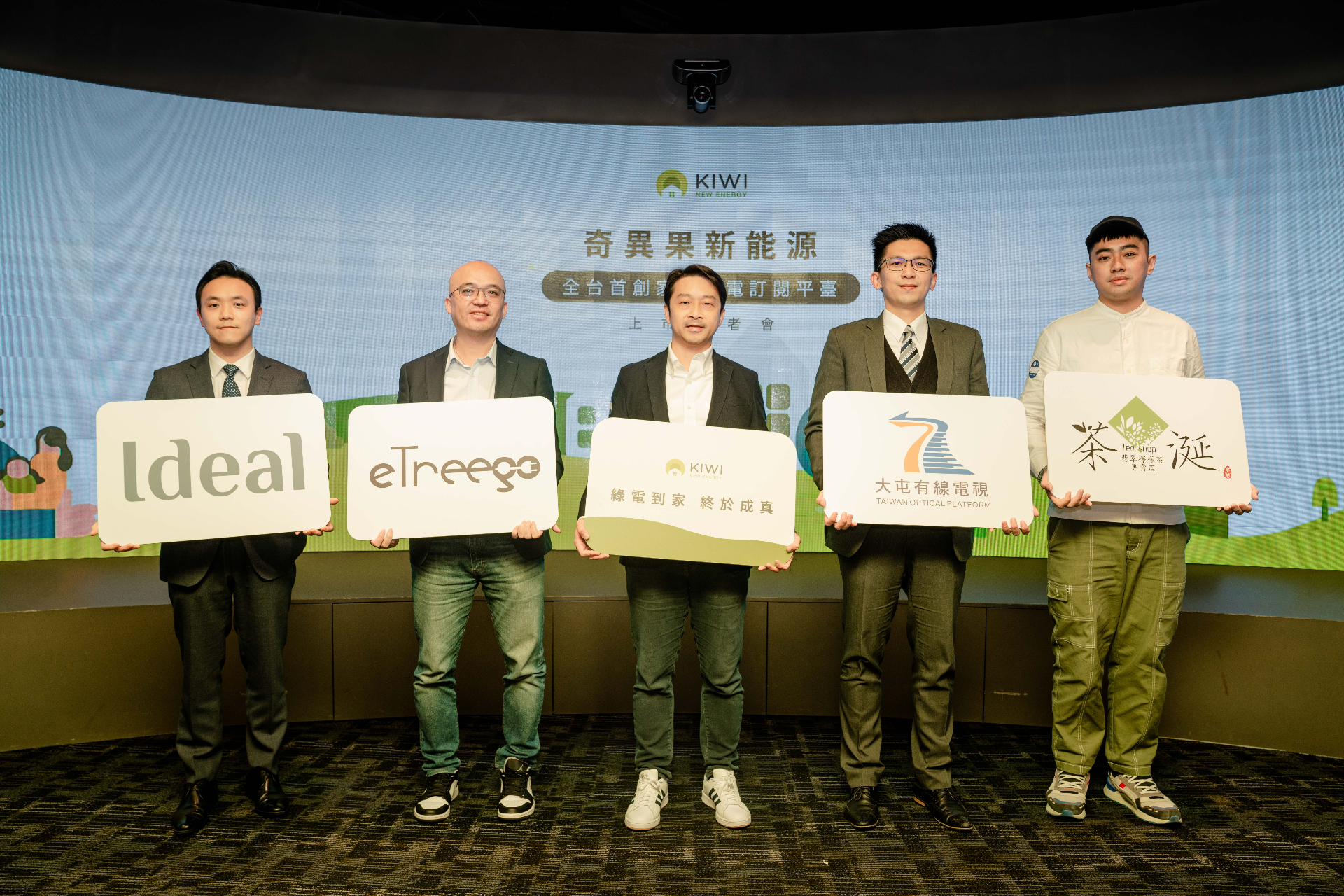
Startup KiWi Energy announced today (1st) the launch of Taiwan's first "Home Green Energy Subscription Platform." This means that by clicking a few buttons on the website to subscribe to a plan, people can get solar green electricity directly delivered by Taipower every month. Furthermore, through AI analysis of electricity consumption data, it is easy to adjust plans, saving up to 15% on electricity bills annually.
Introducing the "Mission Impossible" of direct Taipower delivery, taking a slice of the green energy pie from TSMC
The most amazing highlight of the platform is the four words "Directly Delivered by Taipower," which ensures a stable and safe power supply source. At the launch press conference, every VIP guest could not help but say in their speech: "I originally thought it was an impossible task." This is because the green electricity produced by Taipower has long been bought up by super-large traditional companies like TSMC and UMC. It takes absolute confidence from power generation operators to allocate 5% or 3% of the electricity ordered by traditional industries for this small startup to use.
"This is actually an energy revolution," said founder Huang Wei-zhe. He admitted that the tug-of-war with Taipower was very tough, but the rigid demand from now until 2050 is right in front of us. The average annual carbon emission per person in Taiwan is as high as 12 metric tons, even exceeding that of China, and the proportion of green energy must be gradually increased from 20% to 80%. How can ordinary households and small shops stay out of it?
Huang Wei-zhe has been in the solar energy industry for 16 years. He found that it is really too difficult for ordinary people to build solar equipment for their own use. It requires a cost of at least 600,000 to 1 million NTD, 200 days of administrative procedures, and at least 88 stamps. The threshold is high and troublesome, so he decided to set up a platform to improve the "accessibility" of green electricity.
Is green energy too expensive? Save 5% on electricity bills annually with a minimum monthly payment of NT$499
But the term "green electricity" just sounds super expensive, especially with low supply. Looking at the numbers, the price of solar photovoltaics is actually decreasing year by year. In fact, by 2021, it is not far from the average electricity price, and it is expected to reach price parity by 2025.
Currently, the KIWI platform offers three plans. There is a low-usage plan of "NT$499 per month for 80 kWh," provided for an average monthly usage of 700–1000 kWh, such as dual-income families or office workers who are not home during the day. The second is "NT$999 per month for 170 kWh," suitable for large families with an average monthly usage of over 1000 kWh or people working from home. If it is a small shop or large family with even greater electricity usage, they can also adopt a "customized plan."
Huang Wei-zhe took the first cooperating beverage shop, "Cha Xian," as an example. Its monthly electricity consumption is about 2,500 kWh. After introducing the KIWI plan, it saves NT$130,000 annually. There is also a shared office, "Ideal," with a power consumption of 8,500 kWh, which saved NT$44,000 in electricity bills in a year after using the plan.
All plans will incorporate AI computing technology. Every 15 minutes, it automatically calculates and matches a power plant with a power generation curve similar to the electricity consumption, allowing for the most and best-performing green electricity during these 15 minutes. According to KiWi's statistics, it can save 5%–15% of electricity bills annually. At the same time, the electricity consumption will be settled every month, suggesting a suitable plan to facilitate users to adjust at any time.
Will introduce wind and hydro power plants, expecting to reach 10,000 users next year
KiWi's goal is to reach 1,000 users by the end of this year and is expected to exceed 10,000 households next year. Among similar platforms, the most famous is the British company "Octopus," established in 2015. Since launching its service, it has grown by 50,000 households every month and has over 5 million users so far, "even driving the traditional state-owned power supply to the brink." Calculating with this growth rate and population, if KiWi's service stably takes shape, ideally 16,000 households will join every month.
To meet the needs of more users, in addition to six solar power plants expected to join at the end of the year, they are also negotiating for different green energy sources such as wind power and small hydropower, so that the usage time is not limited to the daytime, gradually increasing the proportion of green electricity. However, as sources increase and become more complex, people might worry about grey electricity being mixed into green electricity. KiWi stated that it has introduced blockchain technology so that the source of every unit of electricity can be traced. People can click directly from the electronic bill to view it, ensuring the power source is clean and without cutting corners.
Next year, there are also plans to open a physical store, "KiWi Store," in Taipei, allowing people to go to the store to pay electricity bills and consult on subscription services, hoping to improve accessibility and let green electricity truly enter our lives.
Related Articles
KiWi at SEMI's AI & Net-Zero Dual Transformation Forum: Dr. Wei-Che Huang Joined as Featured Speaker
On June 17, KiWi founder and CEO Dr. Wei-Che Huang joined SEMI's AI & Net-Zero Dual Transformation Forum as a featured speaker, sharing how AI energy orchestration can help enterprises turn power from a bottleneck into a strategic enabler for decarbonization and industrial upgrading.
KiWi Selected for Startup Terrace IP2 ScaleOut: Landing the AI Energy Operating System in the US
KiWi New Energy has been selected for Startup Terrace's IP2 ScaleOut program — a market-entry initiative that helps Taiwan's most globally-ready startups establish operations, customers, and partnerships in the United States. The kick-off meeting took place last Friday, marking the official start of KiWi's structured US scale-out plan for the AI Energy Datacenter (AI-EDC).